
AI Content
AI generated content is everywhere, and we've seen many clients using it to write, edit, and enhance their content.
In itself, this isn't a bad thing. What matters is that you as a publisher have proof read and are 100% responsible for the content you publish on your website, no matter where it comes from.
We've been told by clients that they're using AI tools to write and edit content, such as:
- ChatGPT
- Grammarly
- RankIQ
We've seen that sometimes this content is easily trackable as AI-generated-content.
We're still very early in this new era of AI, and you should protect yourself from possible repercussions. Read below to learn why.
Jump to:
Hide AI characters
Use the Replace AI-generated-content characters to remove common characters inserted by AI content tools.

While this is not a 100% perfect solution (see "Solution" below), it will quickly and easily remove some of the most easily detectable issues.
Tracking AI content
Many popular AI-content-generating systems and tools insert clues that make it easy to identify the content to computers, but difficult for real people.
This can take the form of specific language/phrases (known as forensic linguistics), content formatting, and special HTML/unicode characters.
The most identifiable one we've come across is the use of white spaces that look like normal spaces but are different characters. Here's a non-extensive list: https://www.compart.com/en/unicode/search?q=space#characters
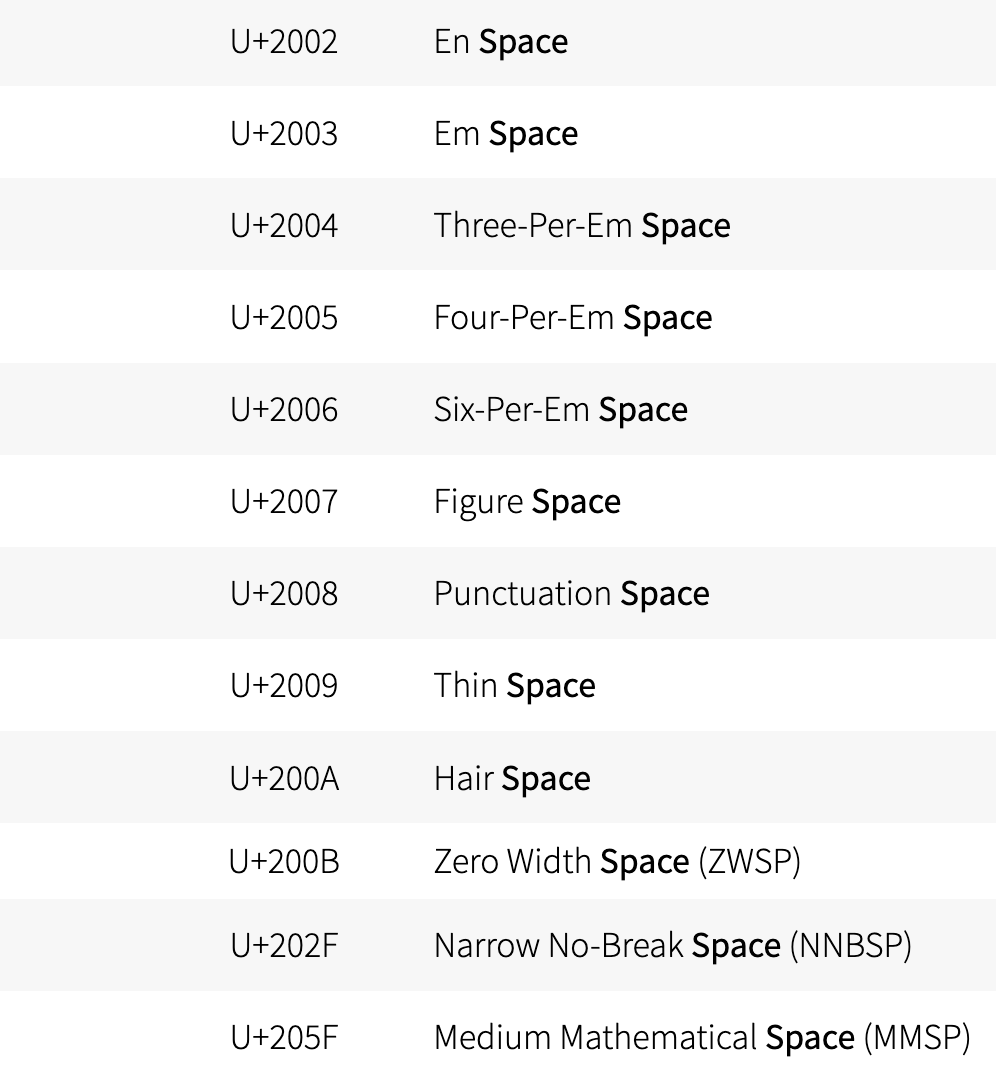
Computers see these as all different spaces, but humans see them as a regular space.
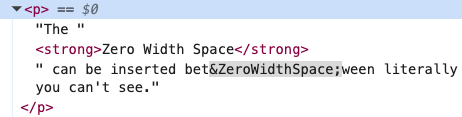
The Zero Width Space can be inserted between literally any letter without notice - there's one in this sentence that you can't see:
SEO
While Google's AI policy currently allows AI content, this can change at any time.
Search engines are not always truthful forthcoming about their policies, and with AI systems controlling more of the ranking algorithm, it's safe to assume that you can't rely on what they say.
And whatever the case may be today, the only thing you can count on is that it's going to change - without notice.
Because of this, we recommend removing all traces of AI generated content, whether it's text or images.
Social
Similar to search engines, social networks allow (and thrive) off AI content currently. You can be sure that they're going to move towards rewarding real creators as they get better at detecting AI-generated-content.
Getting caught in the wrong crowd
Algorithms are trained with human feedback. Real people are paid to view different websites and pieces of content and flag it as good/bad, or in other terms, helpful/unhelpful. This is known as the human quality raters.
If enough people flag content as unhelpful, algorithms are trained to identify similar other pieces of content as similarly unhelpful.
This means that all the garbage AI content that's getting put online and is subsequently flagged as unhelpful, is training algorithms to identify certain characteristics of content as unhelpful.
The algorithms (there's thousands) look at every aspect of a website and piece of content, including hidden characters inserted by AI-content-generating systems that food blogs are blindly copy+pasting into their site.
That means that if your site contains content, such as hidden characters, that a specific algorithm associates with unhelpful content, your content may also be flagged as unhelpful.
It's important to remember that these thousands of algorithms work together to form a cohesive picture and no single thing you do should cause you to lose rankings (except hacking/malware/etc).
But in todays competitive world, you need every single advantage you can get which means that everything else being equal, you should absolutely not have hidden characters inserted by AI-content-generating systems that are designed to track you.
Text overflow
Another less-serious side effect of this is that these hidden/whitespace characters can sometimes cause text to overflow off the screen, because browsers see the whole sentence as a single word, without spaces, which doesn't allow them to reflow text onto the next line normally.
We've seen this arise as "content wider than screen" warnings in Google Search Console.
Accessibility
We haven't tested this thoroughly, but hidden characters may be read aloud by screen readers, which would make the content inaccessible.
Screen readers are specifically designed to read some hidden content for visually impaired users.
Solution
There's a couple things you can do to manage this, from best to least involved:
- The absolute best thing you can do is rewrite content that's AI generated, in your own words, right in the block editor - your unique author voice is your own competitive advantage in todays content world
- The next best thing you can do is run the content through a system to identify and replace these characters (we don't have any recommendations at this time)
- As a fallback, we've added a new Replace AI-generated-content characters feature to the Feast Plugin (v.14.3.0) that can automatically replace these characters with standard spaces (only on the front-end) - must be manually enabled:
- You can also do nothing and pray this isn't a big deal
This is not a complete solution, as tools will continue to evolve and new ways to track content will emerge. For now, we feel like this is a good band-aid and will help all of our users.